So You’re Thinking About Forking
Forking can look like the fastest path to control, but it often becomes a long‑term maintenance tax. Here’s a pragmatic checklist to decide—and alternatives that usually win.
As the open source healthcare developer platform of choice for innovators worldwide, Medplum continues to evolve with the rapidly changing technology landscape. We're excited to announce our upcoming major version release, Medplum v5, scheduled for October 2025. This post outlines the significant changes coming in this release to help our users prepare accordingly.
We've heard many success stories from enthusiastic early adopters who have smoothly upgraded to v4. Thank you all for your support and your feedback in this process!
However, we've identified an issue affecting some Medplum deployments that are configured to automatically pull the :latest Docker tag. With our recent release of Medplum 4.0.0, these deployments may be caught in a failing deployment loop. This post explains why this is happening and how to resolve it.
Medplum v4.0.0 is coming soon! Many of the new features in this release have already been rolled out incrementally, making the v4.0.0 designation more symbolic of the semantic versioning. We prioritize stability and backwards compatibility and work hard to minimize unnecessary changes. However, sometimes changes are necessary to keep the platform up-to-date and secure. This document outlines the key updates in v4.0.0, including important information for self-hosting deployments and TypeScript SDK users.

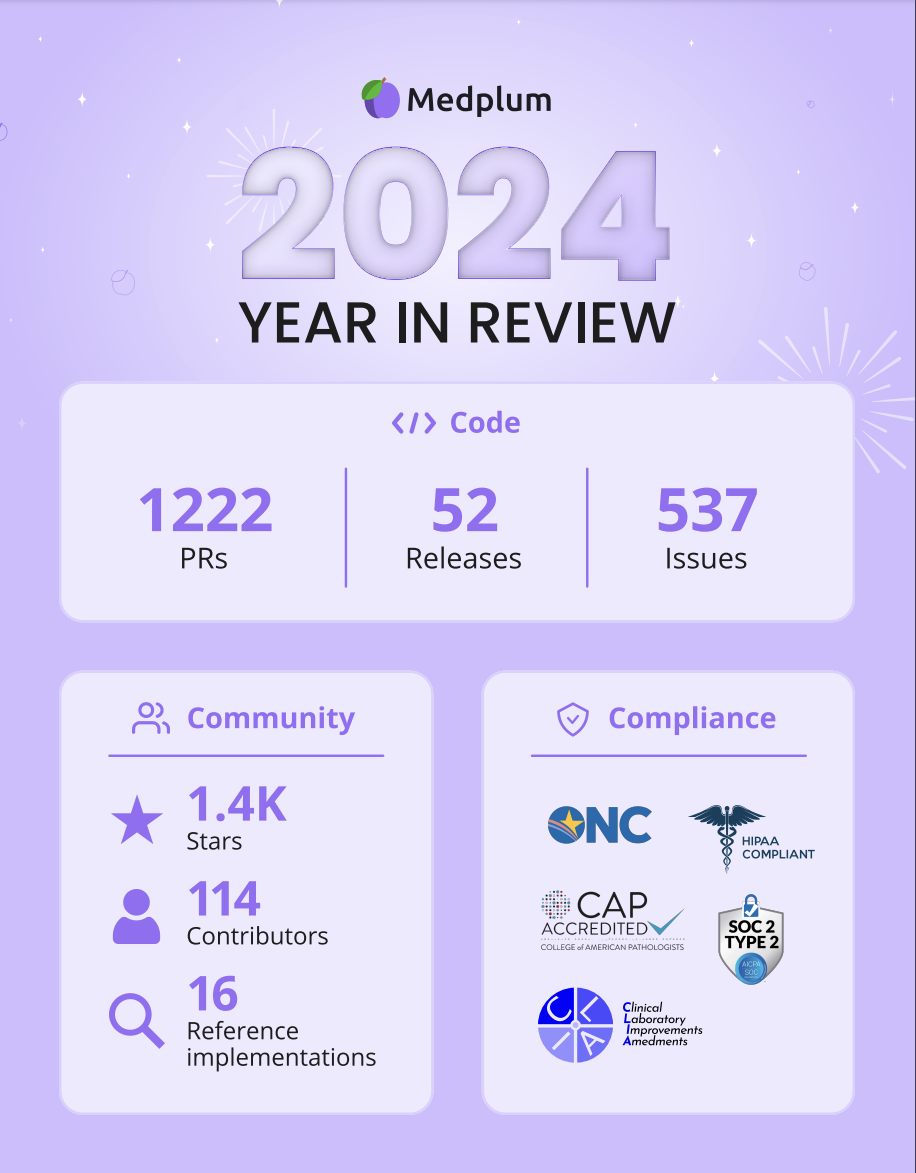
As we close out 2024, the Medplum team would love to thank our community and customers for joining us on this journey.
If you've worked with FHIR before, you've probably noticed there are a lot of resources. And I mean a lot! At first glance, it might seem overwhelming to figure out how they all fit together. But here's the thing: once you understand a few core patterns, the whole system starts to make much more sense.
Today, let's talk about one of FHIR's clever organizational tricks: the Workflow module. It's an pattern overlaid onto resource types that helps unlock how different healthcare activities relate to each other. Whether you're building a scheduling system, managing prescriptions, or handling lab orders, these patterns will come in handy.
Medplum is built on Postgres. Until recently, our hosted Medplum service was using an Amazon Web Services (AWS) RDS Aurora Postgres cluster running version 12.16. Since v12 is rather outdated and nearing the end of its standard support window on RDS, it was time to plan our upgrade to the newest version available on RDS, v16.4. Various methods to upgrade to a new major version on various places across the downtime vs level-of-effort continuum; we decided to upgrade our database with no downtime. This is how we did it.
Chamber Cardio, a technology-enabled cardiology solution, helps enable and empower cardiologists and practices in their transition to value-based care. With our cloud-based technology platform, we offer a suite of tools designed specifically for cardiovascular care. These tools provide real-time insights, analytics and care coordination tools focused on improving outcomes for patients with chronic cardiovascular conditions.
Claims data is a uniquely rich source of financial and clinical data important to many healthcare workflows. The EDI 837 Health Care Claim transaction is one of the oldest forms of electronic data exchange, stemming from being defined as a required data transmission specification by HIPAA.
Develo has built a full-featured EHR and customer relationship management (CRM) for pediatrics, encompassing core scheduling, clinical, and billing workflows along with family engagement capabilities.